
Managing AI Agents Like A High-Velocity Team
Running multiple AI sessions is not like having magic.
It is like managing a very fast team with no memory unless you build it one.
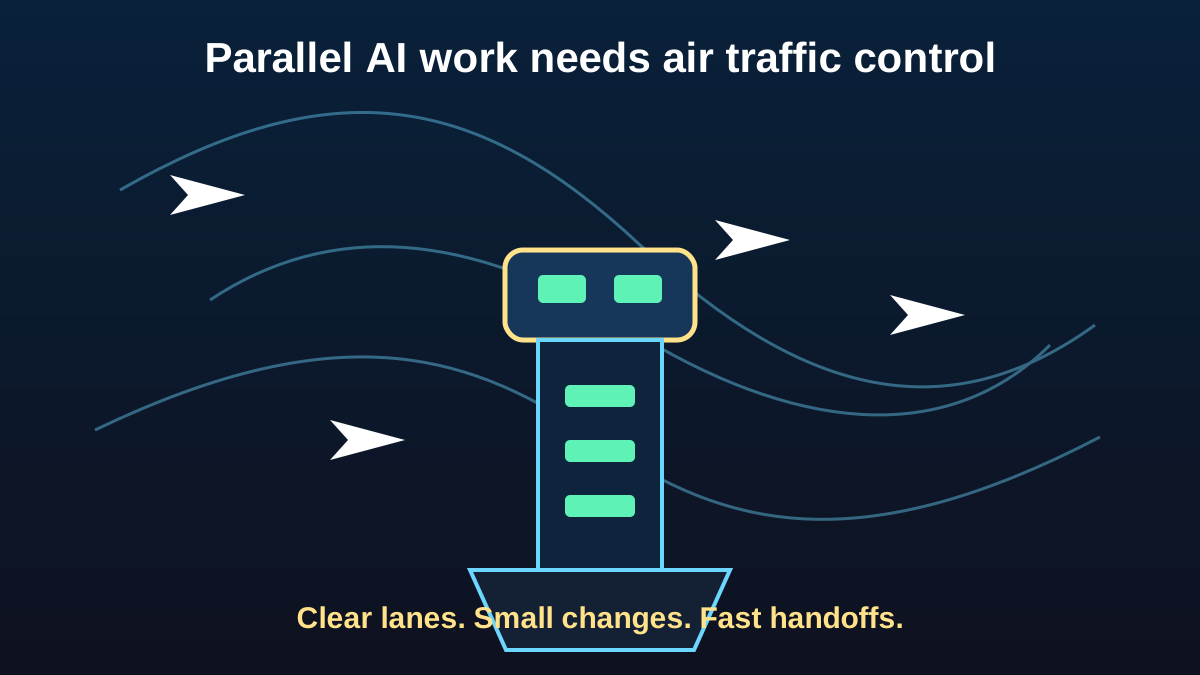
One April week, my repo showed 346 commits. Many were small, focused changes. That was intentional. At that pace, the problem is not whether work can happen. The problem is whether the work remains understandable.
That is the same problem leaders face in fast-growing teams.
AI just compresses the timeline.
Parallelism Is A Leadership Skill
Parallel work is powerful only when the boundaries are clear.
This is true for people. It is true for AI agents. If everyone touches the same shared surface without coordination, speed turns into conflict. If work is split by clear ownership and acceptance criteria, parallelism creates leverage.
The best AI sessions I run have a small charter:
- own this surface
- make this specific change
- do not touch these files
- verify through this path
- report what remains uncertain
That is not micromanagement. It is how you create safe autonomy.
Vague autonomy is not empowering. It is just unclear.
The Managerial Bottleneck Moves To Review
As implementation gets faster, review becomes more important.
This is where a lot of teams will feel pain. If AI doubles the amount of code created but the review process stays the same, the organization has not doubled throughput. It has doubled the review queue.
The answer is not to rubber-stamp AI output. The answer is to make review cheaper and sharper:
- smaller changes
- better tests
- clearer diffs
- stronger ownership
- automated checks before human review
- explicit “done” criteria
In my own work, small commits became essential. They preserved the decision trail. I could see how an idea evolved instead of receiving one giant bundle of plausible changes.
That is a practice I would carry into any AI-enabled engineering team.
AI Agents Need Handoffs Too
One of the more practical things I learned is that AI agents need handoffs.
If a session runs long, it accumulates decisions, failed attempts, assumptions, and context that may not be visible in the final diff. If the next session does not inherit that information, it may repeat work or make the same mistake.
A good handoff is short but concrete:
- what changed
- what was verified
- what is still risky
- what should not be repeated
- where the next session should start
This is just engineering hygiene, but AI makes it more valuable because context windows are finite and sessions are disposable.
If the shared memory is only in chat, the organization is fragile.
What Leaders Can Learn From This
The AI-agent version of the problem is a preview of the human-team version.
High-output teams need:
- clear ownership
- small units of work
- fast verification
- shared context
- written decisions
- strong review norms
AI does not change those fundamentals. It raises the penalty for ignoring them.
The organizations that get the most from AI will likely look more disciplined, not less. More explicit scopes. Better test paths. Cleaner handoffs. More attention to the review bottleneck.
That may sound counterintuitive. The tools feel fluid and conversational, so it is tempting to work loosely.
Loose work does not scale.
The Leadership Read
Managing AI agents is management practice in miniature.
You define the goal. You split the work. You set boundaries. You review output. You improve the system. You decide what matters.
The agents can be fast, but they are not accountable.
The human still is.
That is why AI is not making engineering leadership less important. It is making the leadership part show up earlier, even for individual contributors.