
Redefining Yourself In The Age Of AI
The biggest AI shift for me has not been technical.
It has been identity.
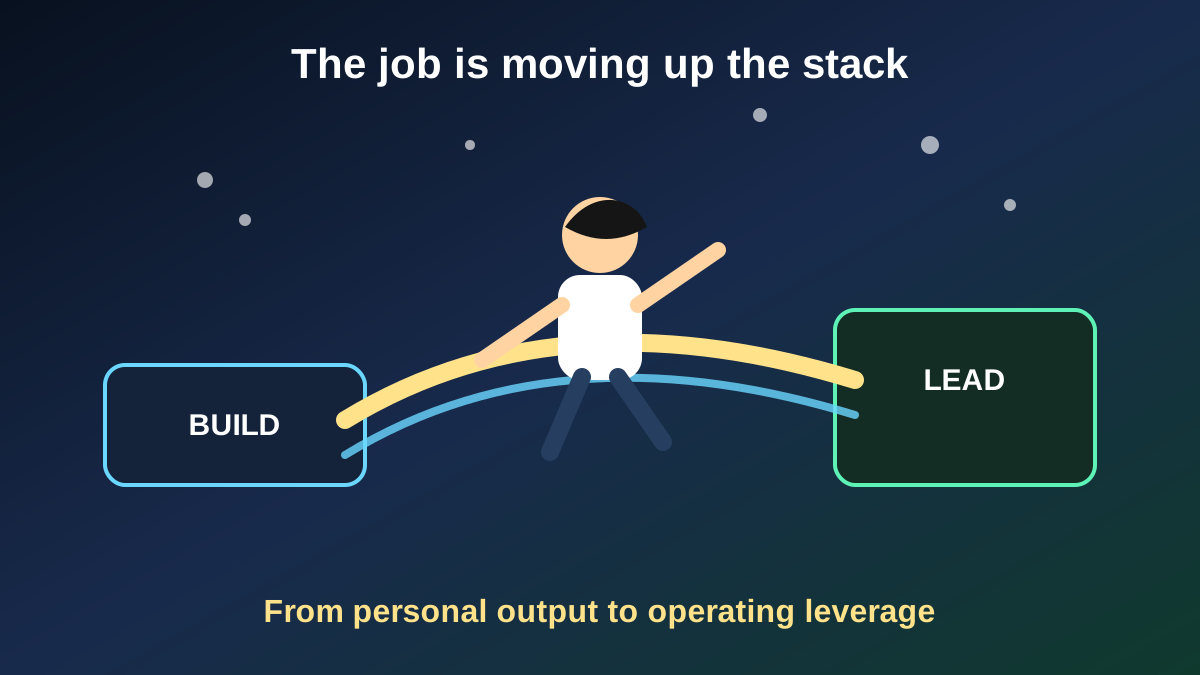
For a long time, part of my professional identity was tied to being able to build. Understand the system, write the code, solve the problem, get it shipped. That still matters. I do not think engineering leaders should drift away from technical reality.
But AI changes what “being technical” feels like.
If a tool can help me produce code, tests, docs, prototypes, and analysis much faster than before, then my value cannot only be the ability to personally type the implementation.
The value moves up.
The New Center Of Gravity
I am still writing code. I am still debugging. I am still inspecting diffs. But more of my energy now goes into higher-leverage questions:
- What is worth building?
- What should be delegated to AI?
- What needs human taste?
- What needs a harness before it needs more code?
- What should become a reusable workflow?
- What should be killed before it becomes debt?
- What context should be moved out of chat and into the system?
Those questions feel more like leadership than traditional solo execution.
That is the shift.
AI turns execution into something you can orchestrate. The human role becomes direction, judgment, verification, and system design.
High Performers Will Need To Change First
I think AI will be emotionally hardest for high performers.
If you built your career on being faster, deeper, or more technically capable than the average person, AI can feel like it is encroaching on the thing that made you distinct.
The way through is not denial.
The way through is moving the bar.
The question is no longer “can I produce more than other people?” It is “can I combine human judgment and AI leverage into a better operating model than other people?”
That is a much more interesting challenge.
It rewards taste, systems thinking, communication, prioritization, and technical depth. It rewards people who can see both the code and the organization.
The Leader As Operating System Designer
The most useful metaphor I have found is that the leader becomes an operating system designer.
Not in the computer science sense. In the organizational sense.
You design how work enters the system. How context is shared. How decisions are made. How quality is checked. How experiments are contained. How tools are used. How AI sessions are scoped. How humans review. How learning turns into repeatable practice.
That operating system determines whether AI creates leverage or chaos.
This applies at every scale:
- an individual managing multiple AI sessions
- a team adopting AI coding tools
- an engineering org changing its delivery model
- a company trying to turn AI into durable advantage
The model matters, but the operating system matters more.
What I Believe Now
I do not believe AI makes engineering leadership less important.
I believe it makes weak leadership more visible.
If goals are vague, AI will generate vague output. If quality is subjective, AI will produce plausible mediocrity. If ownership is unclear, AI will create coordination risk. If review is slow, AI will flood the bottleneck.
But if direction is sharp, systems are clear, and verification is fast, AI can dramatically expand what a small group can do.
That is the opportunity.
Scaling output without scaling people directly is possible. But it requires scaling clarity, judgment, and trust mechanisms at the same time.
What I Am Trying To Become
I am trying to become less attached to being the person who personally pushes every rock uphill.
I want to be the person who designs the hill, the path, the safety rails, the measurement system, and the judgment loop.
That does not mean becoming less technical. It means applying technical skill at a higher level of leverage.
The best engineering leaders in the AI era will still understand the details. They will still know when the work is real. But they will also know how to build systems where humans and AI can produce trusted outcomes together.
That is the work I am most interested in now.
Where I Land
AI is not just changing how I code.
It is changing what I think my job is.
The future belongs to people who can pair ambition with judgment, speed with verification, and personal productivity with system design.
That is not a smaller version of engineering leadership.
It is a more demanding one.