When AI Scales Output, Quality Becomes The Bottleneck
AI makes it easier to create.
It does not make it easier to know what is good.
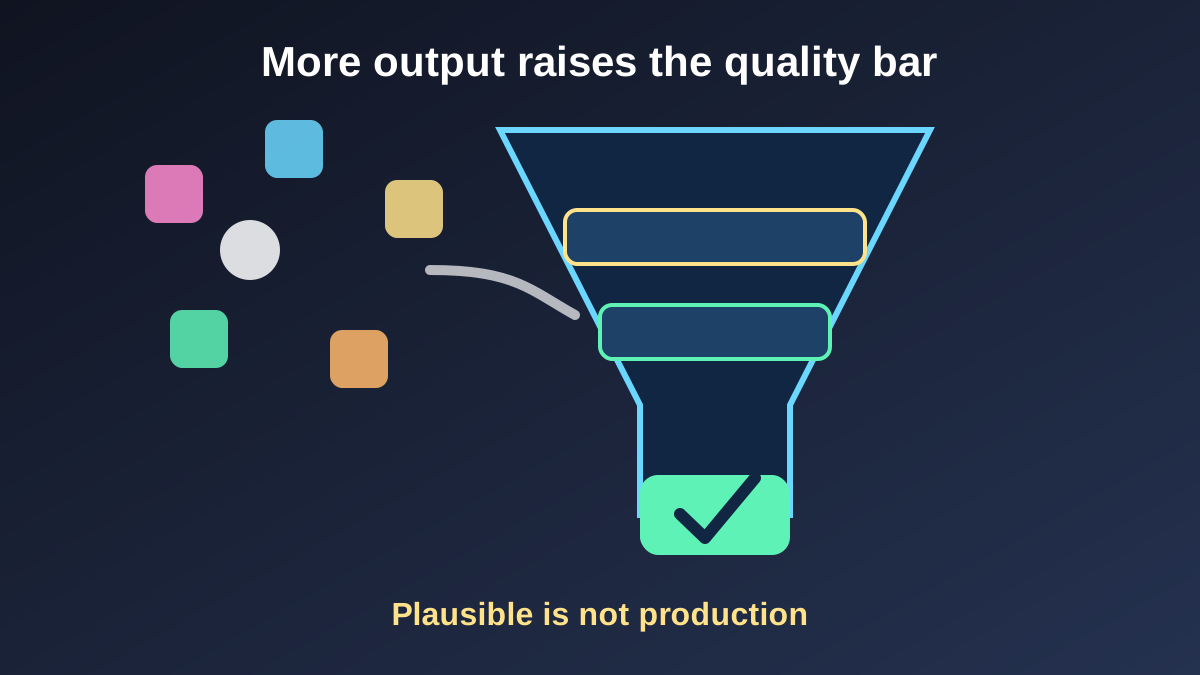
That is the quality bottleneck.
In late April, I ran an intense pass over a product with many user-facing surfaces. The repo showed 223 commits touching 690 files, with a large amount of UI, workflow, testing, and polish work. The details were specific to my project, but the leadership pattern is general: when AI increases output, the system needs stronger ways to decide what is acceptable.
Otherwise, you just produce more almost-done work.
Almost Done Is Expensive
AI is very good at getting to plausible.
The first version compiles. The screen mostly works. The text mostly fits. The interaction mostly makes sense. The test mostly covers the happy path.
That is useful, but it is not done.
In many organizations, the gap between plausible and production-quality is where the real cost lives. It is also where AI can create risk. If a team celebrates the first plausible output, quality drops. If a team builds fast quality gates, AI becomes a force multiplier.
The difference is the system around the work.
Quality Needs Evidence
The most useful shift in my own workflow was replacing opinion with evidence wherever possible.
Instead of “this looks fine,” capture the state.
Instead of “the route works,” run the route.
Instead of “the screen probably handles real data,” seed the real state.
Instead of “the diff seems safe,” run the target verification path.
This matters because AI output often looks coherent. A confident explanation can make a weak change feel stronger than it is. Evidence cuts through that.
For leaders, this is the operating principle: as AI increases the speed of production, increase the speed of verification.
Human Taste Still Matters
Not everything can be automated.
Quality is not only correctness. It is judgment. Is the hierarchy right? Is the user experience clear? Does this solve the actual problem? Is this the right level of complexity? Should we ship this, simplify it, or throw it away?
AI can help surface options and catch mechanical issues, but it does not own taste.
This is where senior people become more valuable, not less. Their job shifts from personally producing every artifact to setting the bar, reviewing output, and building systems that make the bar repeatable.
The best leaders will be able to say two things clearly:
- This is what good looks like.
- This is how we will know when we are there.
The Review Bottleneck Is Strategic
If a team adopts AI and suddenly produces twice as many pull requests, the review bottleneck becomes strategic.
You can solve that badly by lowering standards.
You can solve it better by changing the work:
- smaller diffs
- clearer acceptance criteria
- automated checks
- better fixtures
- explicit ownership
- stronger examples of desired quality
The goal is not to make humans review more hours. The goal is to make each human review more decisive.
That requires investing in quality infrastructure before the output flood arrives.
What I Would Tell Another Leader
Do not ask only how much faster your team can build with AI.
Ask how much faster your team can verify, reject, refine, and ship.
Those verbs matter. AI gives you more candidates. Leadership decides which candidates become product.
If your quality system is weak, AI will expose it. If your quality system is strong, AI will feed it.
That is the difference between acceleration and noise.
The Real Constraint
AI does not eliminate the quality bar.
It raises the importance of having one.
The future high-performing engineering org will not be the one that produces the most artifacts. It will be the one that converts more artifacts into trusted customer value with less drag.
That is a quality system problem.
And it is leadership work.