
AI Makes Verification The Management Layer
The first wave of AI coding feels like a writing-speed upgrade.
The second wave feels like a management problem.
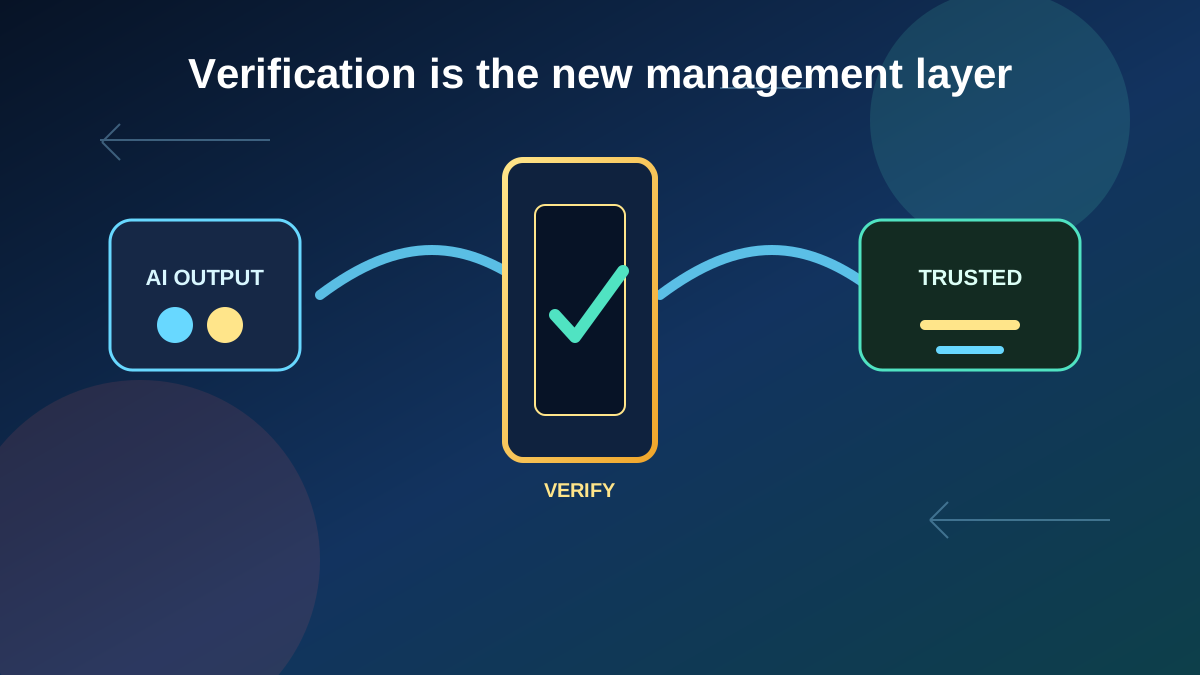
Once AI can produce useful code quickly, the bottleneck moves. It is no longer “can we make the change?” It becomes “can we prove the change works, understand the blast radius, and keep the system moving in the right direction?”
That is a very different job.
In March I was using AI heavily against a real codebase with real runtime constraints. One week had 54 commits touching 225 files. The work included browser runtime parity, automated game flows, quality scoring, debug tooling, and production build verification. On paper, that sounds like a technical story. The more interesting story is managerial: I had to build a verification layer fast enough to keep up with AI-generated output.
That is where I think engineering leadership is going.
Output Is Getting Cheaper
For years, software organizations were designed around scarce implementation capacity. There were always more ideas than engineering hours. Prioritization meant deciding what a limited team could build.
AI changes that equation. It does not make implementation free, but it compresses a lot of the work that used to consume calendar time. A motivated engineer with AI can now explore, refactor, prototype, and polish at a pace that would have required multiple people not long ago.
That is exciting. It is also destabilizing.
When output gets cheaper, weak quality systems get exposed. If review, testing, rollout discipline, and product judgment do not scale with the new output rate, the organization does not get faster. It just creates more change than it can safely absorb.
The companies that benefit most from AI will not be the ones that generate the most code. They will be the ones that build the strongest verification loops.
The New Managerial Surface
The managerial surface for AI-assisted engineering is not only people. It is the work system around the people.
Can a change be tested without heroic manual effort?
Can a new session understand the rules without a private meeting?
Can a build prove the right thing, not just compile?
Can the system catch regressions before the human reviewer is exhausted?
Those questions sound operational, but they are strategic. They determine how much AI leverage an organization can actually use.
In my own work, the turning point was moving from “the AI made the change” to “the AI made the change and the real target path verified it.” That meant explicit build loops, browser checks, repeatable scenarios, and written operating rules.
The code mattered. The verification loop mattered more.
A Real Example
One of the most useful shifts was treating runtime verification as part of the deliverable.
A clean compile was not enough. The browser had to load. The local server path had to be correct. Sound assets had to resolve. The scenario had to run through the same path a real user would hit.
That sounds obvious until you are moving fast. AI can produce a plausible fix in seconds. It is very tempting to accept the diff because it reads well. But a readable diff is not a working system.
This is the discipline I now want around AI work:
- every task has a concrete acceptance path
- the acceptance path is executable where possible
- the real runtime matters more than the static argument
- a human does judgment, but the system does the repetition
That is the shape of scalable AI-assisted engineering.
What Leaders Should Watch
If you are leading an engineering organization, I would watch for a quiet shift in where time goes.
Your best engineers may spend less time typing implementation code and more time building the scaffolding that lets AI work safely: test harnesses, golden paths, evaluation scripts, local development flows, repo instructions, and small deployable units.
Do not mistake that for overhead.
That scaffolding is the multiplier.
An AI-enabled engineer without verification can produce a lot of untrusted output. An AI-enabled engineer with strong verification can create a step-change in throughput while keeping quality legible.
That is the real management layer.
The New Bar
The question for leaders is not “how do we get everyone to use AI?”
The better question is: “what would have to be true for us to trust a much higher rate of change?”
That question points to the actual work. Better tests. Clearer ownership. Faster environments. Smaller changes. Better review protocols. More explicit product intent. Fewer tribal rules.
AI makes verification the management layer because output is no longer the scarce resource it used to be.
Trust is.