Internal Tools Are The AI Multiplier
AI does not reduce the value of internal tools.
It increases it.
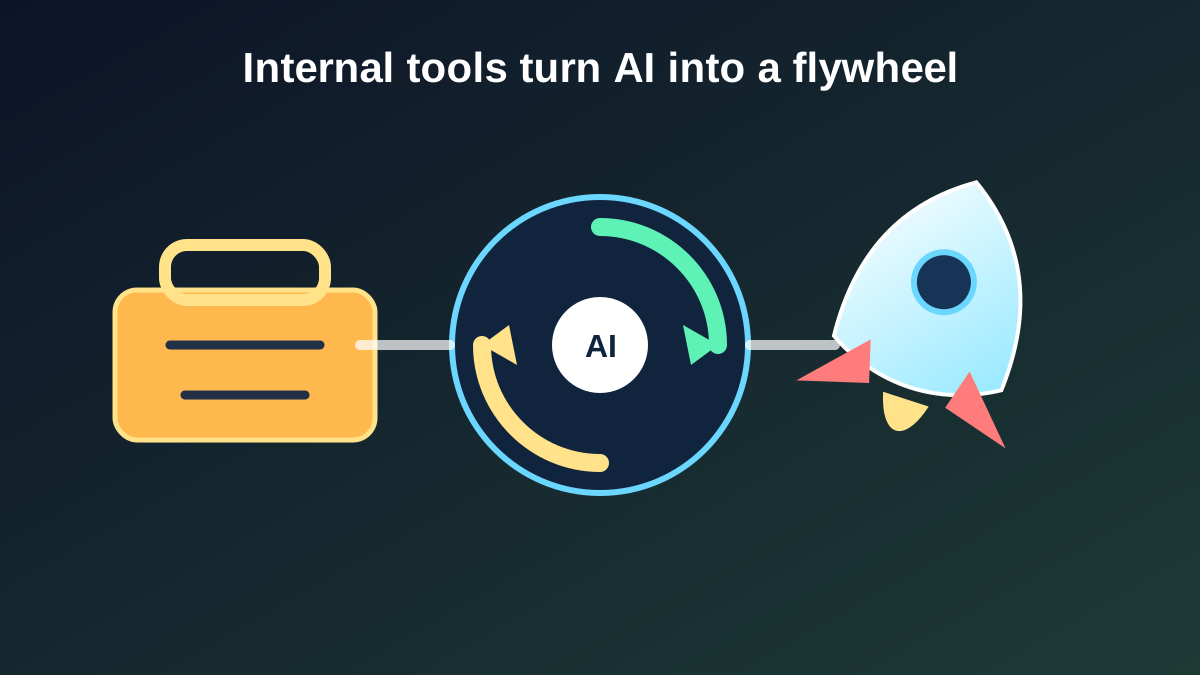
That surprised me at first. If AI can read the codebase, write code, and run commands, maybe tooling matters less. Maybe the model can just figure things out.
In practice, the opposite happened.
The better the tools, the more useful the AI became.
In early April, I spent time building and tightening labs, audit routes, source-of-truth definitions, test harnesses, and repeatable workflows. The raw commit count was modest compared with other weeks, but the leverage was high. The work made future AI sessions faster, safer, and easier to direct.
That is the pattern I would expect to see in high-performing engineering organizations too.
Tools Turn Ambiguity Into Work
Consider the difference between these two requests:
“Improve this product area.”
“Use this tool, load this fixture, compare against this target, make the smallest change that closes the gap, and run this verification path.”
The second request is dramatically better for AI. It is also dramatically better for humans.
Internal tools give work a shape. They expose state. They create repeatable entry points. They reduce the need for private explanation. They let multiple sessions or multiple people operate on the same surface without reinventing the setup every time.
That is why tooling compounds with AI.
The model is good at execution, but it still needs a clear environment. A good internal tool gives it one.
The Best Tooling Is Not Always Fancy
Some of the most valuable tools are simple:
- a local server that starts the right surfaces
- a test harness that exercises the important path
- a fixture that creates meaningful state
- a JSON file that becomes the source of truth
- a dashboard that makes health visible
- a script that captures screenshots consistently
None of that sounds like a moonshot.
But when AI is producing more candidate work, these tools become the difference between scalable iteration and chaos.
They let me turn broad intent into constrained action. They also let me evaluate output faster.
That is the real multiplier.
What This Means For Engineering Leaders
Many leaders underinvest in internal tools because the ROI is hard to see in the short term.
AI changes that math.
If a tool saves a human engineer 15 minutes once a week, maybe it is hard to prioritize. If that same tool becomes the entry point for dozens of AI-assisted iterations, the leverage grows quickly.
Internal tools are not just for human convenience anymore. They are operational interfaces for human-plus-AI teams.
This means platform teams, developer experience teams, and quality infrastructure should become more important, not less.
The organizations that get serious about AI should also get serious about the surfaces AI operates through.
The Executive Filter
Not every internal tool is worth building.
The best candidates have three properties:
- They reduce repeated context.
- They make verification cheaper.
- They turn judgment into a repeatable workflow.
If a tool does those three things, it likely improves both human and AI productivity.
If it only makes a process look more sophisticated, skip it.
AI does not need more dashboards for their own sake. It needs sharper operating surfaces.
The Multiplier
The future of AI-enabled engineering is not just better models.
It is better environments for models to work inside.
Internal tools are how an organization expresses its preferred way of working. They encode what matters, what good looks like, and how to verify progress.
That is why I now see tooling as a leadership investment.
The tool is not the product customers buy. But it may be the reason your team can keep improving the product faster than everyone else.