
AI Expands The Option Space. Taste Decides What Ships.
One of the best uses of AI is not doing the known work faster.
It is making more options cheap enough to evaluate.
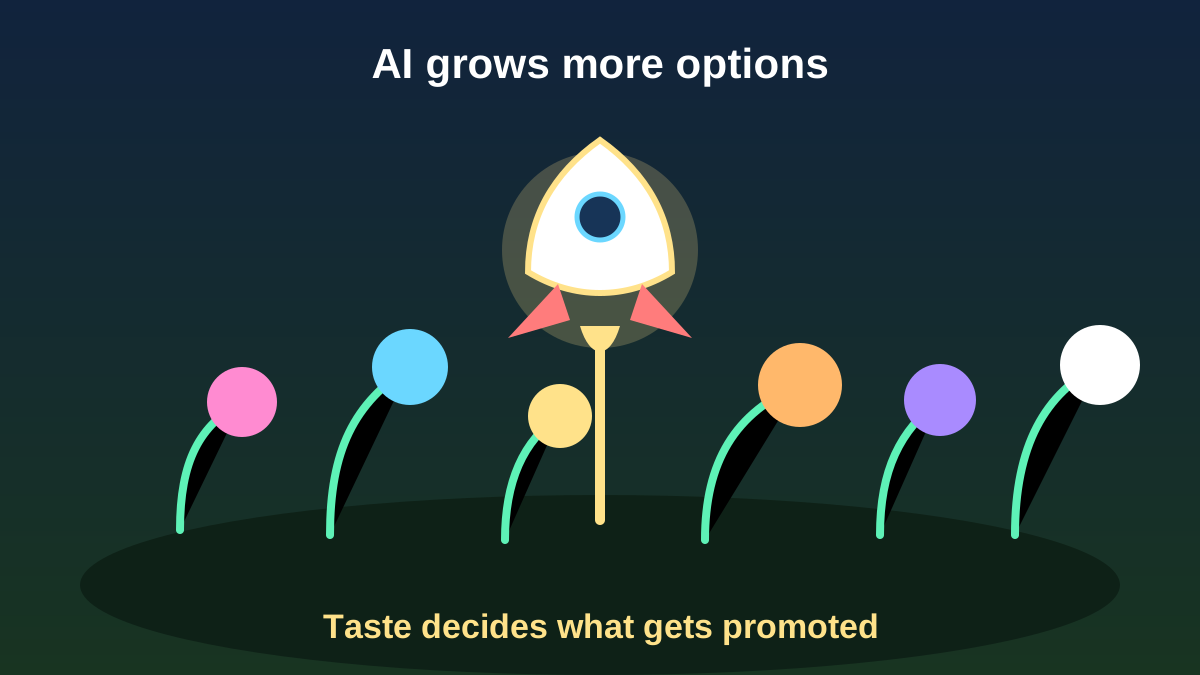
In late April, I used AI to explore a large set of product and design variants in a short period of time. The specific work was in a game, but the pattern applies broadly: AI made it possible to create many candidate directions, test them, compare them, and decide which ones deserved more investment.
That is a major shift.
But it comes with a warning: more options do not automatically mean better decisions.
Exploration Gets Cheaper
A lot of product decisions are constrained by the cost of trying.
You do not build ten variants because building ten variants is expensive. You pick two, debate them, prototype one, and hope your instincts were right.
AI changes that cost structure.
It can generate more alternatives, wire up prototypes, summarize tradeoffs, and help build evaluation paths. That means leaders can move from theoretical debate to practical comparison more often.
This is powerful. It gives taste more material to work with.
Instead of asking “which idea sounds best?” you can ask “which idea survives contact with reality?”
Taste Becomes The Promotion Filter
The danger is that teams start shipping the exploration set.
AI can produce five plausible solutions. That does not mean all five deserve to become product. In fact, most should not.
The human role is promotion.
Which prototype has the clearest user value? Which one fits the strategy? Which one is simple enough to maintain? Which one creates the right emotional response? Which one is clever but distracting? Which one should be archived as a useful dead end?
That is taste, and taste is not a soft skill in this context. It is a business capability.
AI expands option space. Taste decides what ships.
Why This Matters For Leaders
Many organizations are built around scarcity of exploration. Roadmaps become conservative because experiments are expensive. Teams avoid weird ideas because the cost of learning is high.
AI can lower that cost.
That should make leaders more ambitious, but not less disciplined.
The new operating model should encourage more exploration while creating stricter promotion gates. More prototypes, fewer accidental commitments. More variants, clearer strategy. More learning, less long-term clutter.
This is where product and engineering leadership need to work together closely. Engineering can make exploration cheap. Product has to make selection sharp.
The Portfolio Mindset
I have started thinking about AI-assisted exploration like a portfolio.
Some work is core and needs production discipline immediately. Some work is experimental and needs a sandbox. Some work is intentionally disposable. Some work is a spike that should become documentation, not code.
The mistake is treating every AI output as if it belongs in the mainline.
That is how projects accumulate complexity.
The better pattern is:
- generate options quickly
- test them in a bounded environment
- keep the evidence
- promote only the winners
- delete or archive the rest
This lets AI increase creativity without increasing permanent surface area at the same rate.
What I Would Tell A Team
Use AI to widen the aperture.
Then be ruthless about narrowing it.
A team that only uses AI to implement pre-approved tasks may get faster, but it will miss some of the creative upside. A team that uses AI to generate endless options without a strong filter will drown in its own output.
The advantage is in the combination: broad exploration, sharp selection.
That is where leadership matters.
The Choice Point
AI is not just a productivity tool. It is an option generator.
That can make a team more creative, more empirical, and less afraid to test unconventional ideas.
But the leader’s job is not to admire the number of options.
The leader’s job is to choose.