The Leadership Skill AI Does Not Replace
One of my most productive AI weeks had zero commits.
That sounds like a contradiction only if we define productivity as visible output.
After several weeks of heavy AI-assisted work, I hit a quiet stretch. No commits in the repo. No big visible push. Just the kind of pause that looks empty on a graph.
But that pause mattered.
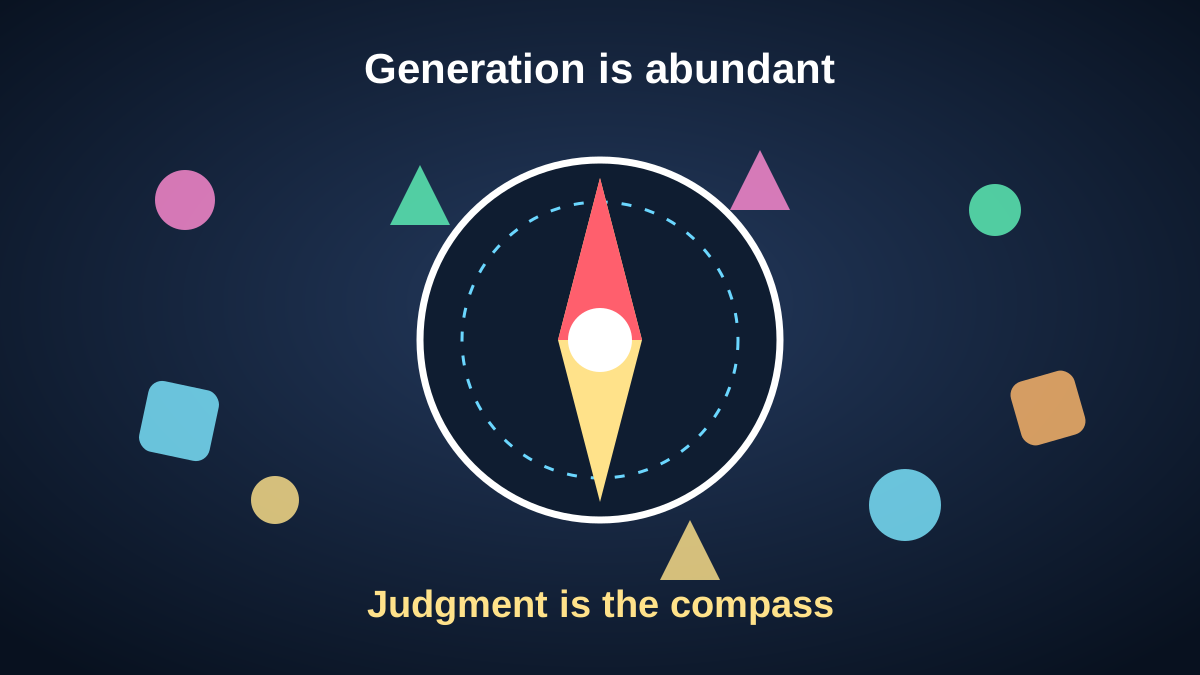
AI makes motion cheap. Judgment becomes the scarce resource.
The Temptation To Keep Generating
AI tools are always ready.
They do not get tired in the same way. They do not complain about another pass. They will generate more options, more polish, more refactors, more tests, more copy, more ideas.
That constant availability creates a new leadership trap: mistaking continuous generation for continuous progress.
I have felt this directly. When the system is working, it is hard to stop. You can push another feature, run another agent, try another variant, fix another edge case. The marginal cost feels low, so the discipline to say “not now” becomes more important.
The question is not whether AI can do more.
The question is whether more is the right next move.
Strategic Pauses Are Not Slowness
In a traditional organization, leaders already know that teams need planning time, design time, review time, and recovery time. No one expects a healthy team to produce only uninterrupted implementation.
With AI, it is easy to forget that.
Because the tool can keep producing, the human starts treating every pause as underutilization. That is dangerous. The human is still the strategy layer, the taste layer, and the accountability layer.
If that layer gets tired, vague, or reactive, output quality drops.
A strategic pause lets you ask:
- What did we just create?
- What actually improved the product?
- What should be deleted?
- What should stay experimental?
- What did we learn about the process?
- What deserves the next burst of effort?
Those questions are not optional. They are how AI output becomes direction instead of accumulation.
The Executive Version Of This Problem
At organizational scale, this will show up as AI activity dashboards that look impressive while outcomes stay muddy.
More pull requests. More prototypes. More documents. More experiments. More internal tools. More everything.
Some of that will be valuable. Some will be noise.
The executive skill is deciding what to amplify and what to stop.
This is not new, but AI raises the stakes. When generation was expensive, scarcity forced prioritization. When generation gets cheaper, leaders need more explicit filters.
That filter is strategy.
Without it, AI can help an organization run faster in circles.
Personal Reinvention Starts Here
This has changed how I think about myself as an engineer.
I used to measure a lot of my value by how much I could personally build. That still matters, but it is no longer the whole story. AI can help me build far more than before.
So the differentiator moves up the stack.
What should exist? What should not? What is good enough? What is worth hardening? What needs a system, not another patch? What should be communicated? What should be turned into an operating rule?
Those are leadership questions.
AI is pushing individual contributors toward leadership behaviors and pushing leaders toward more concrete technical judgment.
That is a healthy pressure if we embrace it.
What I Would Tell A High-Output Team
Do not celebrate AI output by itself.
Celebrate the conversion rate from output to trusted value.
If a team generates 50 prototypes and ships one great product decision, that can be excellent. If a team generates 50 prototypes and carries all 50 forward, that is debt.
AI makes exploration cheaper. It does not make focus less important.
The ability to stop is becoming a competitive advantage.
The Point Of The Pause
The leadership skill AI does not replace is judgment.
Not vague executive judgment. Concrete judgment applied repeatedly: this matters, this does not, this is ready, this needs verification, this should be killed, this should be scaled.
AI can increase the number of decisions in front of you.
It cannot make you a better decision-maker by default.
That part is still on us.