Stop Writing Better Prompts. Build Better Systems.
Prompting matters.
It is also the easiest part of AI transformation to overvalue.
After enough serious AI-assisted work, I keep coming back to the same conclusion: the biggest gains do not come from clever prompts. They come from better systems around the prompts.
In mid-March, I was working through a large codebase with multiple AI sessions, multiple runtimes, build constraints, and enough moving parts that chat history alone was not a reliable operating model. That week had 20 commits touching 253 files, but the important change was not volume. It was the shift from “tell the AI what to remember” to “make the environment carry the rules.”
That is the move I think many engineering organizations need to make.
Prompts Are Not Infrastructure
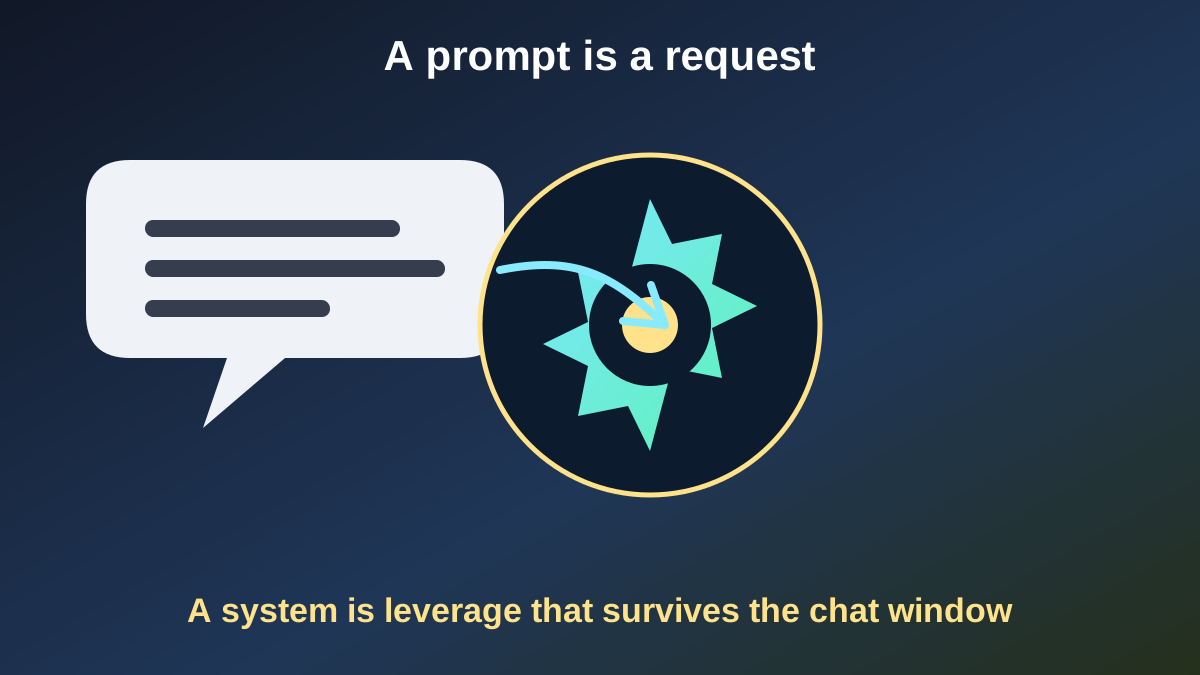
A prompt is a request. It is not a contract.
If an instruction matters once, put it in the prompt. If it matters every time, put it in the system.
That system might be repo documentation, a test harness, a schema, a workflow file, a code owner boundary, a pull request checklist, a local development command, or a generated source of truth.
The form matters less than the principle: important context should not depend on one conversation window.
This becomes obvious when you hit context limits, switch models, restart sessions, or hand work from one AI tool to another. If your process relies on a long chain of remembered chat, the workflow is fragile.
AI-native engineering needs durable context.
The Real Upgrade Is Operational
I started with the same instinct a lot of people have: learn how to ask better questions.
That helps. But the bigger upgrade was operational:
- write down the rules that should never be violated
- create repeatable build and test loops
- make acceptance criteria executable
- isolate experimental work
- keep shared systems behind clear contracts
- document handoffs so the next session starts cleanly
This sounds less exciting than prompt engineering. It is also where the real leverage shows up.
Once the operating system is explicit, the AI can move faster with fewer mistakes. It does not have to infer everything. It does not have to ask the same questions. It does not have to rediscover the build path or the safety rule.
The environment becomes a co-manager.
Why Leaders Should Care
This has a direct leadership implication.
Many organizations will roll out AI tools and then wonder why productivity gains are uneven. Some teams will see real acceleration. Others will see scattered experiments, inconsistent quality, and local wins that do not compound.
The difference will often be the surrounding system.
Teams with clean boundaries, strong tests, clear ownership, fast environments, and explicit product goals will absorb AI much better than teams that rely on tribal knowledge and heroic reviewers.
AI exposes organizational debt.
If the build takes too long, AI makes that pain more visible. If requirements are vague, AI generates plausible wrong answers faster. If ownership is unclear, AI changes the wrong files. If review is weak, AI increases the amount of unreviewed risk.
The tool is not the strategy. The operating model is.
What I Would Tell Another Engineering Leader
Do not start by asking, “what prompt should my team use?”
Start with:
- What context do we keep repeating?
- What rules are currently tribal?
- What paths are hard to verify?
- What work is too risky to parallelize?
- Where do reviewers become the bottleneck?
- What does done actually mean?
Answering those questions will improve AI results more than another prompt template.
Prompt templates are useful. But if the team has to paste a page of fragile instructions into every session, that is a signal. The system is asking chat to do the job of infrastructure.
Where The Leverage Compounds
AI does not reward the team with the fanciest prompt library.
It rewards the team with the clearest operating model.
Prompts are how you express intent in the moment. Systems are how you make that intent survive time, scale, model changes, and human fatigue.
That is why I am spending more energy on workflows, docs, tools, and verification than on trying to find the perfect phrasing.
Better prompts help one task.
Better systems improve every task after it.